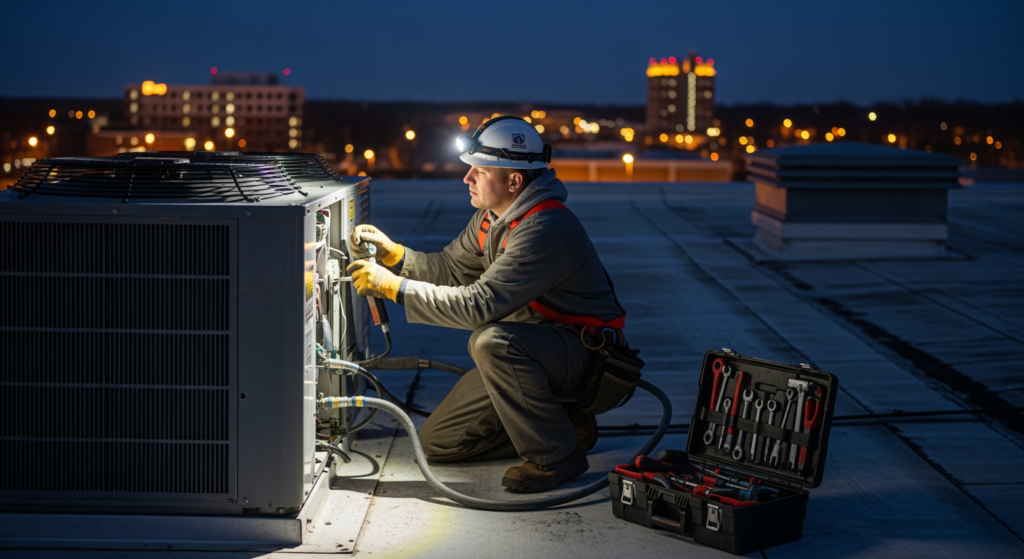
Quick answer: If your business relies on stable temperatures, ventilation, or refrigeration, 24/7 emergency commercial HVAC service is worth it. After-hours failures can spoil inventory, shut down equipment, and create unsafe conditions for staff and customers. A true emergency provider can dispatch quickly, diagnose fast, and make safe temporary or permanent repairs so you can reopen, protect product, and stay compliant.
What Counts as an HVAC Emergency for a Business
An HVAC “emergency” isn’t just discomfort—it’s anything that threatens safety, product, operations, or the building itself. Think a rooftop unit that quits during a heat wave, a furnace that won’t fire on a freezing night, or a make-up air unit that stops and leaves a kitchen full of smoke and negative pressure.
Refrigeration problems often become urgent even faster. A walk-in cooler running warm, a freezer alarm, or repeated breaker trips can turn into a total loss of food, florals, or pharmaceuticals. If you’re wondering whether to call right away, a good rule is: if waiting until morning could cause spoilage, water damage, unsafe indoor air, or a forced closure, it’s an emergency and you want access to Sun Prairie 24/7 emergency commercial HVAC service rather than hoping the issue holds.
Some problems start small but escalate quickly—burning smells, loud metal-on-metal noises, ice buildup on lines, or water dripping through ceiling tiles. Those are signals to shut the system down if needed and get a technician involved before a minor repair becomes a compressor, heat exchanger, or electrical failure.
What to Expect When You Call After Hours
Emergency service should be structured, not chaotic. The dispatcher will usually ask what equipment is affected (RTU, boiler, walk-in, split system), what symptoms you’re seeing, and whether there are safety concerns like gas odor, smoke, or flooding. Having the unit model/serial, thermostat readings, and any alarm codes ready speeds up the response.
On arrival, the tech’s first job is to make the site safe—confirm power, gas, and refrigerant conditions—then stabilize operations. Sometimes that means a permanent fix on the spot (failed capacitor, contactor, fan motor, igniter). Other times it’s a safe temporary solution to protect product and people until parts are available, like isolating a circuit, recovering refrigerant properly, or setting up a controlled shutdown plan.
You should also expect clear communication: what failed, what was done tonight, what still needs attention, and how to prevent a repeat. Good emergency work includes documenting pressures/temps, electrical readings, and any code-related concerns so the next visit isn’t starting from scratch.
How to Reduce Emergency Calls Without Losing Coverage
Even with 24/7 coverage, prevention saves money and stress. The biggest wins usually come from routine filter changes, coil cleaning, checking belts and bearings, verifying drain lines, and confirming economizers and dampers move freely. For refrigeration, keeping condenser coils clean and door gaskets tight can prevent a lot of late-night temperature alarms.
It also helps to set simple internal checks for staff: what to do when a unit alarms, where disconnects are, who has access to mechanical rooms, and when to move product to backup cold storage. If your building has multiple zones or tenants, label thermostats and panels so the right equipment gets addressed quickly.
Finally, ask your provider to flag end-of-life components during normal maintenance—weak compressors, pitted contactors, failing inducer motors—so you can schedule replacements on your terms instead of at 2 a.m.
Choosing the Right Emergency HVAC Provider in Sun Prairie
Look for a company that routinely services commercial equipment similar to yours—rooftops, make-up air, boilers, controls, and refrigeration—not just residential systems. You want technicians who can troubleshoot electrical and control issues, carry common commercial parts, and follow proper refrigerant handling and safety procedures.
Ask how calls are prioritized, what the typical response process is, and whether you’ll get a clear repair plan when parts or follow-up work are needed. A reliable provider should also help you document what happened for internal reporting or insurance when equipment damage or product loss is involved.
If you want help setting up dependable after-hours coverage and keeping your systems from becoming repeat emergencies, Nextech is a solid place to start.